Most STP problems announce themselves loudly. A pump trips, a blower stops, an alarm sounds. Sludge is different. When wasting and desludging slip behind schedule, nothing breaks on day one. The plant keeps running, the treated water still looks acceptable, and the logbook still says “normal”.
Underneath, though, solids keep piling up: in the aeration tank, at the bottom of the clarifier and in a holding tank that was only meant to be a short stop. This guide follows that build-up step by step. It covers what happens to the biology, how treatment quality slips, why maintenance work multiplies and why disposal becomes the hardest part to catch up on.
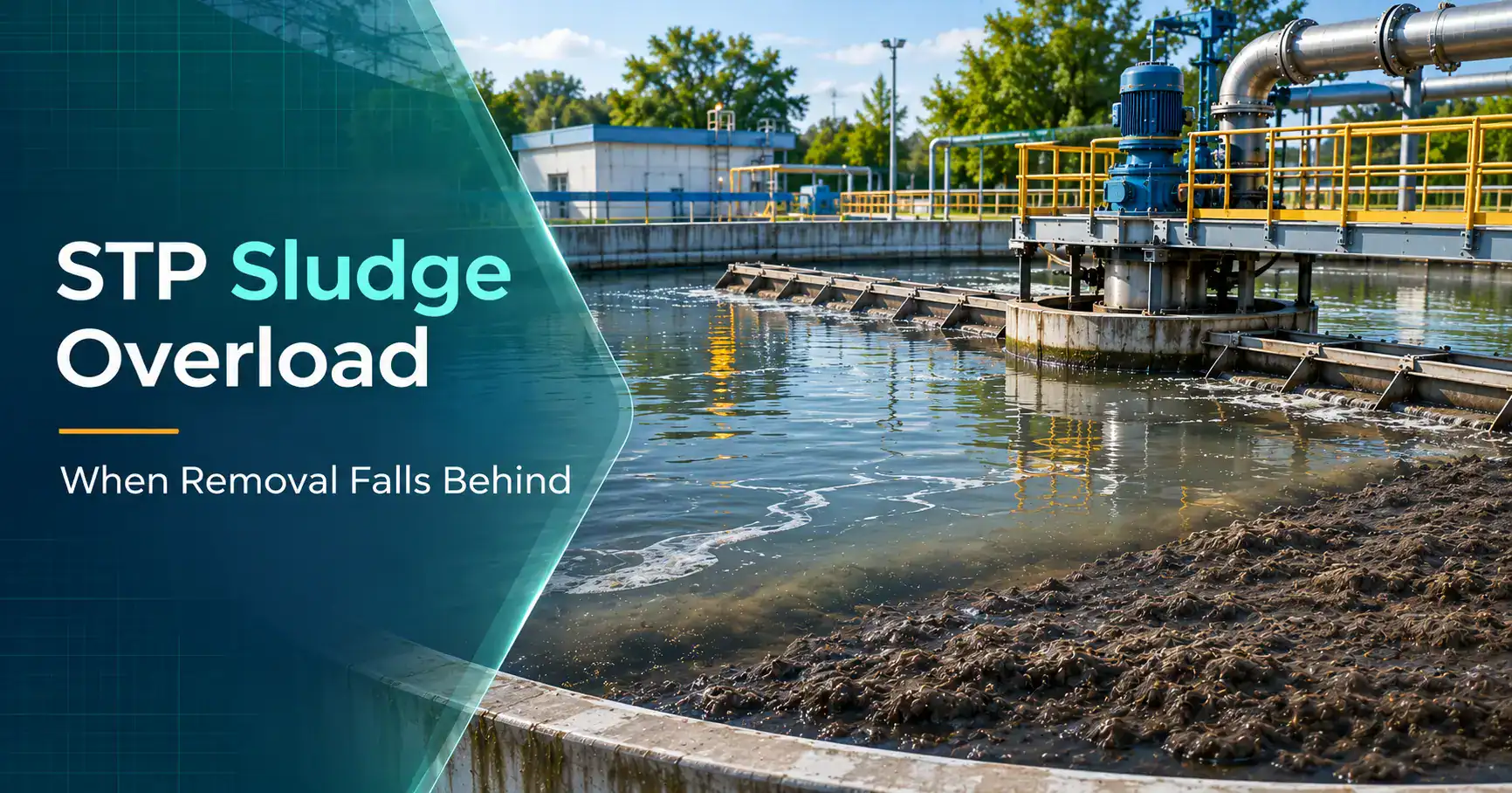
When sludge removal falls behind, surplus solids crowd the aeration tank, push the clarifier’s sludge blanket upward and turn stored sludge septic. Treated water turns hazy, odour and foam appear, filters and pumps work harder, and the backlog of sludge to dewater and dispose of grows faster than routine work can clear it.
Why Every STP Makes Sludge, Every Single Day
A biological STP works by feeding the organic load in sewage to a large population of microorganisms. As they consume that load, they multiply. Part of the new growth is returned to keep the process strong, but the surplus has to leave the system every day. Otherwise the plant slowly fills with its own biomass.
That surplus is the sludge. Removing it is not a clean-up job to schedule “when there is time”. It is part of how the plant stays in balance.
When that brown path slows down, the solids do not disappear. Maybe a sludge pump is out of service, the holding tank is full, the dewatering unit is waiting for a repair or a tanker visit keeps getting postponed. Whatever the reason, the solids stay in the process and start changing how it behaves.
Slide the Calendar: Watch a Missed Schedule Unfold
Drag the slider to push sludge removal further behind schedule and watch what happens across the plant. The exact timing depends on the plant’s size, design margin and load, but the order of events is remarkably consistent.
Simplified illustration. Real timing depends on plant size, design margin, incoming load and how the plant is operated.
Inside the Aeration Tank: The Biology Gets Crowded
In an activated sludge process, operators control the plant mainly through how much sludge they return and how much they waste. Wasting sets the sludge age, which is how long the average microorganism stays in the system. When wasting stops, sludge age keeps rising and the mixed liquor suspended solids (MLSS) climb with it.
A crowded aeration tank sounds like it should treat better. In practice it does the opposite. More biomass means more oxygen demand, so dissolved oxygen falls even with the blowers running hard. Older sludge settles poorly, forms fine “pin floc” that refuses to settle, and encourages the thick brown foam that is common on overloaded plants.
Conventional activated sludge usually runs around 2,000–4,000 mg/L. It keeps climbing when nothing is wasted.
Often held around 1.5–2 mg/L. It falls as a bigger biomass demands more oxygen.
Below about 150 mL/g usually settles well. Higher means poor settling and carry-over.
Too much biomass for the incoming load starves the floc and weakens settling.
Controlled by wasting. It rises day after day when wasting stops.
One simple test catches most of this early: the 30-minute settling test, or SV30. A litre of mixed liquor is left to settle in a measuring cylinder. If the settled sludge volume keeps creeping up week after week, wasting is not keeping pace with growth.
In the Clarifier: When the Sludge Blanket Starts Climbing
The secondary clarifier has one job: let the biomass settle so only clear water flows over the weir. It is designed for a certain solids load. When the aeration tank sends more than that, the settled layer at the bottom, called the sludge blanket, gets thicker and rises towards the surface.
A high blanket leaves less clear water above it, so fine solids get swept out with the treated water. Sludge that sits too long at the bottom also runs out of oxygen. Bacteria then convert nitrate into nitrogen gas, and the tiny bubbles lift clumps of sludge back to the surface. Leave it longer still and the sludge turns septic: black, gassy and smelling of rotten eggs.
Fine floc and solids are escaping because the sludge blanket is too close to the clarifier outlet weir.
Old, over-aged sludge tends to favour foam-forming bacteria. The tank is carrying far more biomass than it should.
Sludge held too long is turning nitrate into nitrogen gas. The bubbles lift settled sludge back to the surface.
Stored sludge has gone septic. Hydrogen sulphide is forming, bringing odour complaints and corrosion of concrete and metal.
Tap or press Enter on a card to flip it.
Treatment Quality Slips, Stage by Stage
Solids escaping from the clarifier do not stop there. They travel downstream and load every stage that follows. The tertiary filters in an STP, typically a pressure sand filter followed by an activated carbon filter, are meant to polish water that is already clear. They are not built to catch sludge.
- 1Screening & equalisation
Unaffected at first
Coping - 2Aeration tank
Low oxygen, foam, over-aged sludge
Stressed - 3Clarifier
Blanket rises, solids escape
Overloaded - 4Sand filter
Clogs faster, needs more backwashing
Overloaded - 5Carbon filter
Media coated, shorter media life
Stressed - 6Disinfection
Solids shield bacteria from chlorine or UV
Stressed
The end result is treated water that may no longer meet the quality limits in the plant’s consent, and recycled water that is less suitable for flushing, landscaping or cooling towers. Residents and facility users usually notice cloudy flushing water long before anyone reads a lab report.
The Maintenance Bill Starts Growing
A sludge backlog does not just reduce treatment quality. It moves work from planned routines into urgent repairs. Equipment sized for normal solids levels runs harder, runs longer and wears out faster.
Run at full output to chase oxygen; diffusers foul faster.
Thick, heavy sludge strains pumps and chokes pipelines.
Compacted sludge loads the scraper or clogs settler packs.
More backwash cycles and early media replacement.
Longer press runs; septic sludge blinds the cloths.
Full tank, septic contents and odour complaints.
Battery levels show relative remaining margin, for illustration only. Flip the switch to compare a plant on schedule.
Catch-up work is also slower than routine work. Compacted, septic sludge is harder to pump and harder to dewater. Clearing a six-week backlog often takes more effort than six weeks of steady wasting would have, and it usually adds odour control, extra chemicals and hired tankers to the bill.
The Disposal Backlog: Where Does All That Sludge Go?
Waste sludge leaves the process as a thin liquid that is mostly water. Before it can be transported and disposed of, it has to be thickened and dewatered, usually on sludge drying beds or in a mechanical unit such as an STP filter press system. Dewatering shrinks the volume dramatically, which is exactly why falling behind is so costly.
Approximate figures for illustration. Actual solids content depends on the sludge, the thickening method and the dewatering equipment.
When dewatering stops, each day’s sludge stays as liquid, at roughly 25 times the volume it would take up as cake in this example. The holding tank fills quickly, and the only quick fix is a tanker to haul liquid sludge, the most expensive way to move it. Dewatered sludge also has to be handled and disposed of as permitted by the local authority and the pollution control board, so records and transport need to keep pace with production.
A Sludge Routine That Keeps the Plant on Schedule
Staying ahead of sludge mostly comes down to measuring a few things regularly and acting on what they show. Tap the dial to see what belongs in each part of the routine.
- Check dissolved oxygen in the aeration tank
- Run the 30-minute settling test (SV30)
- Waste the planned volume of surplus sludge
- Look at the clarifier surface and treated-water clarity
- Record every reading in the logbook
- Measure the clarifier sludge blanket depth
- Test MLSS and work out the SVI
- Run the filter press or drying beds on schedule
- Check the sludge holding tank level
- Review sludge age and adjust the wasting rate
- Inspect sludge pumps, valves and pipelines
- Check filter press cloths and polymer dosing
- Book transport and disposal for dewatered sludge
- Inspect diffusers and blower performance
- Compare treated-water test reports with consent limits
- Service the clarifier mechanism or clean tube settlers
- Update the O&M plan to actual sludge production
If the routine is already slipping because the site team is stretched, an annual maintenance contract or full operation and maintenance support can take sampling, wasting and dewatering off their hands, with someone accountable for keeping the schedule.
Quick Check: Is Your STP Already Behind?
Answer six yes-or-no questions about your plant as it is today. The tank fills as warning signs add up, and the verdict tells you how urgent a sludge review is.
The Bottom Line
Sludge removal falling behind is rarely dramatic on the first day, which is exactly why it gets postponed. The chain that follows is predictable. Excess solids crowd the aeration tank, the clarifier blanket climbs and treated-water quality slips. Equipment works harder, and the backlog of sludge to dewater and dispose of grows faster than routine work can clear it.
The fix is just as predictable. Measure settling and solids regularly, waste sludge every day, keep dewatering and disposal moving, and treat a rising sludge blanket as an early warning, not a later problem.
Tell us about your STP. We’ll work out how far behind it is.
Frequently Asked Questions
In activated sludge plants, surplus sludge is usually wasted every day in small amounts, guided by settling tests and MLSS readings. Holding tanks, drying beds and dewatering units then run on a weekly or fortnightly rhythm, depending on plant size and load. Smaller systems such as bio septic tanks need periodic desludging instead. The right frequency comes from your plant’s design and its measured sludge production.
Common signs are hazy treated water, thick brown foam on the aeration tank, sludge clumps floating in the clarifier, a rising sludge blanket, a full holding tank and a rotten-egg smell. Dissolved oxygen falling even though the blowers are running hard is another early warning.
Yes. When the sludge blanket rises, solids escape with the treated water and push up suspended solids and BOD. Those solids also load the sand and carbon filters and reduce the effectiveness of disinfection, so the treated water may no longer meet the quality limits in the plant’s consent.
Sludge wasting is the routine, controlled removal of surplus biomass from the biological process, usually daily, to keep sludge age and MLSS in range. Desludging is the removal of sludge that has accumulated in a tank, such as a holding tank, settling tank or septic tank, often by pump or tanker. A plant needs both to stay on schedule.
Waste sludge is first thickened and dewatered, typically on drying beds or in a filter press, to cut its volume. The dewatered cake is then disposed of or reused as permitted by the local authority and the State Pollution Control Board, and quantities should be recorded. Nanneer Solutions can help set up dewatering and a disposal routine that suits your plant. Request a quote to get started.