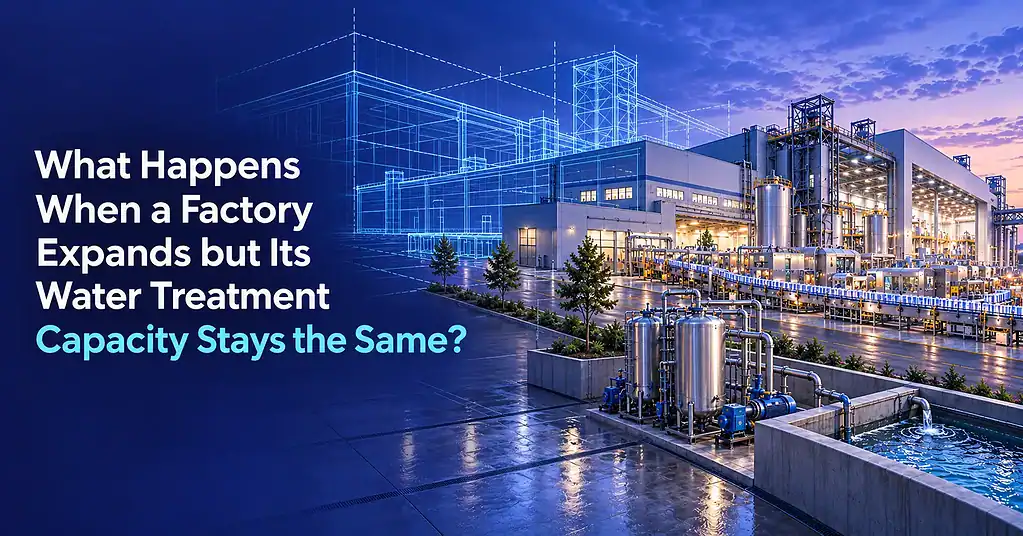
What Happens When a Factory Expands but Its Water Treatment Capacity Stays the Same?

Water Treatment Capacity Stays the Same
When a factory doubles its output, management tracks raw material costs, hiring, and logistics. What often goes untracked — until something breaks — is water. The Effluent Treatment Plant or Sewage Treatment Plant commissioned for the original plant size is now asked to handle a volume it was never designed for. This guide walks through every consequence — discharge quality, regulatory exposure, equipment stress, and water availability — and what a well-planned capacity upgrade looks like.

The Typical Timeline

Year 0 — Plant Commissioned
ETP/STP sized for original production. Everything balanced.
Year 2–3 — Expansion Begins
Production ramps. Water use rises. Treatment load quietly crosses design capacity.
Year 4 — Compliance Fails
Effluent BOD spikes. PCB notices. Production halted pending audit.
Year 4+ — Upgrade or Shut Down
Emergency capacity expansion at 3× the cost of planned upgrade.
4 Areas Affected
01
Discharge Quality & Compliance
02
Water Availability & Recycling
03
Plant Reliability & Equipment Stress
04
Cost of Inaction vs Planned Upgrade
The Mechanism

How Overcapacity Silently Builds Up

Capacity overload in a treatment plant is rarely a sudden event. It accumulates in stages — each individually manageable-seeming, until the cumulative effect crosses a threshold.
1
Production volumes increase
More raw material throughput means more process water used — washing, cooling, steam, cleaning. Water consumption grows roughly proportionally with production, sometimes faster.
2
Wastewater flow rate climbs
The volume of wastewater entering the ETP/STP per day rises. Hydraulic Retention Time (HRT) — the time water spends in each treatment stage — shrinks proportionally. Biology and chemistry both need time to work.
3
Organic and chemical load increases
Higher production generates more BOD, COD, suspended solids, and trade-specific contaminants. The treatment plant receives a higher pollutant mass per day than it was designed for.
4
HRT drops below minimum threshold
When HRT in an aeration tank falls below ~6–8 hours for activated sludge systems, biological treatment efficiency collapses. BOD removal drops from 95%+ to 60–70%.
5
Discharge quality breaches consent standards
The treated effluent now contains BOD, COD, or TSS above the limits specified in the State PCB consent order. Every discharge event is a compliance violation.
HRT Collapse — What the Numbers Look Like
Original design (100% load)HRT: 10 hrs ✓
125% production loadHRT: 8 hrs ⚠
150% production loadHRT: 6.5 hrs ✗
200% production loadHRT: 5 hrs — biological failure
Aeration tank volume fixed. Flow doubles → HRT halves. Biological treatment fails before discharge limits are reached.
Consequence 1 of 4

Discharge Quality Collapses — and the Regulator Notices

The most immediate and legally consequential effect of capacity overload is the deterioration of discharge quality. CPCB consent limits exist for a reason — and exceeding them repeatedly is not a technical issue, it is a criminal liability.
BOD & COD Spike
Biological oxygen demand rises as HRT drops. Partially oxidised organics pass through the system. Effluent BOD that was 10 mg/L at design load can reach 40–80 mg/L at 1.5× load.
Suspended Solids Carryover
Overloaded secondary clarifiers lose their sludge blanket. Biological floc carries over into the final discharge, raising TSS and turbidity well above consent limits.
Ammonia Breakthrough
Nitrification requires longer HRT than BOD removal. When HRT falls, nitrifying bacteria are washed out first. Ammonia-nitrogen in the effluent rises sharply — a parameter that CPCB and State PCBs monitor closely.
TDS Concentration
As process water is used and recycled without adequate desalination, total dissolved solids accumulate in the plant circuit. The ETP cannot remove TDS — only dilution or RO can. At high loads, TDS in discharge climbs.
PCB Enforcement — What Happens Next

→

Show Cause Notice — issued within days of a monitoring visit finding non-compliant discharge

→

Closure Direction under Section 33A of Water Act 1974 — production stoppage pending compliance

→

Environmental Compensation — assessed at ₹5,000–₹50,000/day of violation under NGT guidelines

→

Consent Renewal Denial — future consent to operate may be refused until full compliance is demonstrated
Consequence 2 of 4

Water Availability Drops — Exactly When You Need More of It

A factory expansion increases freshwater demand at the same time as it degrades the quality of treated water available for reuse. The water budget breaks in both directions simultaneously.
The Broken Water Budget
Freshwater intake
At 150% production, freshwater demand rises 50%. Same municipal/borewell allocation — now insufficient.
Recycled water output
An overloaded ETP produces lower-quality treated water — unsuitable for internal reuse in cooling or washdown.
Net water deficit
More tanker purchases. Higher cost. Higher carbon footprint. Production line bottlenecks from water shortages.
The Reuse Opportunity Being Missed

A properly sized Membrane Bio-Reactor or upgraded ETP with tertiary polishing can recover 60–80% of process water for internal reuse. At 150% production scale, this represents significant freshwater savings and a substantial reduction in both water procurement costs and wastewater disposal costs. An overloaded system produces none of this benefit — it is discharging potential asset as waste.

Internal Reuse Applications That Fail First
  • ▸
    Cooling tower makeup water — requires treated water meeting TDS and turbidity standards. Overloaded ETP cannot supply this.
  • ▸
    Floor washing & equipment cleaning — requires BOD-treated water free of suspended solids. Only reliably available when plant runs within design load.
  • ▸
    Green area irrigation — the lowest bar, but still requires coliform and BOD within limits. Overloaded plants routinely fail even this standard.
  • ▸
    ZLD compliance — Zero Liquid Discharge mandated for certain sectors (textile, tannery, pharma) in notified areas. Capacity overload makes ZLD compliance technically impossible.
Consequence 3 of 4

Equipment Stress and Plant Reliability Degrade

Every mechanical and biological component in a treatment plant was sized against a design flow and organic load. Sustained overloading degrades each component faster — and failures become correlated, meaning they cluster together under stress.
Aeration Blowers
Sized for design oxygen demand. At 150% load, blowers run at 100% duty continuously. No standby margin. Bearing failures from thermal overload increase from once every 3 years to once every 8 months.
Clarifier & Settling Tanks
Overflow rate (m³/m²/hr) exceeds design. Sludge blanket rises. Biological floc exits with the effluent. Secondary clarifier performance collapses before any other unit.
Sludge Pumps & Filter Press
Sludge production scales with organic load. Pumps and presses sized for original production run out of capacity. Sludge backs up into the aeration tank — reducing effective tank volume further.
Dosing Pumps (Coagulant/Disinfection)
Chemical dosing rates were calibrated for original flow. At higher loads, same dose per day means under-dosing on a per-litre basis. Coagulation and disinfection both weaken.
Online Monitoring Instruments
Flow meters, DO sensors, and pH controllers designed for original conditions are now operating outside their calibrated range. Readings become unreliable — masking the severity of the problem.
Breakdown Frequency Comparison
Blower Failure (per year)
Normal load
0.3×
150% load
1.5×
Clarifier Carryover Events
Normal load
Rare
150% load
Weekly
Unplanned Downtime (days/yr)
Normal load
3–5d
150% load
18–25d
Consequence 4 of 4

The True Cost of Doing Nothing — Planned vs Reactive

The cost of upgrading treatment capacity is a known, manageable capital expenditure when planned ahead. When it happens reactively — triggered by regulatory action or equipment failure — the same work costs several times more and carries additional losses from downtime and penalties.
Planned Capacity Upgrade
Capacity audit & engineering
₹1.5–3L
Phased tank/blower expansion
₹15–40L
MBR or tertiary upgrade
₹20–60L
Commissioning & calibration
₹3–8L
Total (planned, phased)
₹40–110L
Reactive Emergency Response
Emergency shutdown losses
₹10–50L/week
PCB penalties & legal fees
₹5–25L
Emergency equipment sourcing
2–4× planned cost
Consent re-application delays
3–9 months lost
Reputational damage
Unquantifiable

The decision window matters: A capacity audit triggered by the expansion decision — before production ramps — costs 10–20% of what the same work costs under emergency conditions. The engineering is identical; the urgency premium is not.

The Solution Path

How to Plan a Treatment Capacity Upgrade the Right Way

The upgrade path is not complicated — but it must be sequenced correctly to deliver compliance without interrupting production.
→
Capacity Audit
Commission an independent hydraulic and organic load audit. Map actual vs design HRT, SRT, F:M ratio, and sludge production. Establish headroom remaining at current and projected production.
→
Load Projection
Model wastewater flow, BOD, COD, TSS, and trade-specific parameters at 125%, 150%, and 200% production. Identify which parameters breach limits first and at which load factor.
→
Technology Selection
Match the upgrade technology to the gap. Incremental volume increase (new tank), process intensification (MBR upgrade), or tertiary polishing (RO for reuse) — each has a different cost-benefit profile depending on discharge targets.
→
Phased Implementation
Sequence the upgrade to avoid production interruption. Stage 1 delivers headroom for the immediate expansion; Stage 2 future-proofs for the next growth phase. Each stage is independently commissioned and compliant.
→
Ongoing Monitoring
Install real-time flow, DO, BOD surrogate (COD online), and TSS monitoring with alarm thresholds at 80% design capacity. Next expansion triggers an automatic capacity review — not a compliance failure.

Nanneer

Nanneer Solutions — Expansion-Ready Design

Nanneer Solutions has upgraded treatment capacity for over 50 industrial facilities across South India where original systems were running beyond design load. Every engagement begins with a hydraulic audit — not a sales call. We design the upgrade around your expansion roadmap, not just today’s problem, so the next growth phase doesn’t trigger another emergency. View our ETP solutions or request a capacity audit.

Key Takeaways

Treatment capacity must be part of every expansion business case — not an afterthought addressed after production ramps.
HRT collapse is the mechanism behind most compliance failures in expanding factories. When flow doubles, biological treatment time halves.
Reactive upgrades cost 3–5× more than planned ones — and carry additional losses from PCB penalties, shutdown, and consent delays.
Water reuse potential is destroyed by overcapacity — the same investment that fixes compliance can also deliver 60–80% water recycling if designed with reuse in mind.
Equipment stress under overload is cumulative and self-reinforcing — blower failures reduce DO, which further reduces treatment efficiency, which increases load on the clarifier.

A treatment plant that cannot keep pace with production is not just a compliance risk — it is an operational constraint that limits how fast the business can grow. Solving it proactively, as part of the expansion plan, removes that constraint permanently.

Is Your Treatment Plant Ready for Your Next Expansion?

Nanneer Solutions offers a free capacity headroom assessment for facilities planning production expansion. We review your current plant data, project the load at your target production level, and tell you — in plain terms — how much headroom remains and what the upgrade path looks like.
✓Current HRT and hydraulic load analysis
✓Load projection at 125%, 150%, 200% production
✓Technology options and indicative cost estimate
✓PCB compliance gap identification
No obligation. Site visit for Chennai & surrounding districts included.
Nanneer
Nanneer Solutions
Chennai · 15+ years in water treatment
Request Free Capacity AuditView ETP SolutionsExplore MBR Technology
Response within 1 business day

Frequently Asked Questions

How do I know if my ETP is already overloaded?
The earliest signs are: effluent BOD rising despite the same inlet concentration; aeration blowers running at 100% duty without shutdown cycles; increased sludge carryover in the secondary clarifier; and more frequent equipment maintenance calls. A hydraulic load audit confirms it.
Can I increase capacity without building a new tank?
Often yes. MBR (Membrane Bio-Reactor) technology can double biological capacity in the same tank footprint by replacing secondary clarification with membrane filtration — eliminating the clarifier overflow problem and increasing SRT independently of HRT. This is one of the most effective capacity expansion routes for constrained sites.
How long does a capacity upgrade take?
A phased upgrade with Nanneer Solutions typically takes 3–6 months from audit to commissioning, depending on the scale of work. Emergency reactive upgrades under regulatory pressure often take longer because procurement, approval, and installation overlap chaotically.
Will I need to shut down production during the upgrade?
No — a well-planned upgrade sequences construction so the existing plant remains operational throughout. New tanks are built in parallel; cutover happens during a planned maintenance window, typically over a weekend.
What is the payback period for a capacity upgrade investment?
For most industrial sites, the combined savings from water reuse (reduced freshwater procurement), avoided PCB penalties, and reduced unplanned downtime deliver payback within 18–36 months of commissioning the upgraded system.
Does Nanneer Solutions handle the PCB consent amendment process?
Yes. An upgrade to treatment capacity typically requires amendment of the Consent to Operate with the State PCB. Nanneer supports clients through the technical documentation, application, and site inspection processes that follow a capacity expansion.
Share it on
Facebook
Twitter
LinkedIn
Reddit
WhatsApp

Looking for Water Treatment Expert?

Nanner is team of water treatment experts for affordable solution.
WhatsApp