

How Does an Effluent Treatment Plant Improve Industrial Wastewater?

Effluent Treatment Plant Explained

“Industrial wastewater left untreated is not just an environmental problem — it is a financial and legal liability that compounds with every passing day.”

Every industrial facility — from a textile dyeing unit to a pharmaceutical plant, a food processing factory to a tannery — generates effluent: wastewater loaded with chemicals, suspended solids, heavy metals, dyes, oils, and biological contaminants. Discharging this water untreated into drainage networks, rivers, or land is not just harmful to the environment — it is a direct violation of CPCB and SPCB norms that can result in shutdowns, heavy fines, and criminal liability for facility owners.

An Effluent Treatment Plant (ETP) is the system that transforms this harmful industrial wastewater into water that is safe to discharge or reuse. Far from being a compliance checkbox, a well-designed ETP is an asset that reduces operating costs, recovers water for reuse, and protects your facility’s license to operate. This guide explains exactly how it works, what it removes, and why every industrial facility generating process wastewater needs one. To explore certified ETP solutions, visit our Effluent Treatment Plant page.

What Exactly Is Industrial Effluent — and Why Is It Dangerous?

Not all wastewater is the same. Industrial effluent is fundamentally different from domestic sewage — it contains industry-specific contaminants at concentrations that can be lethal to aquatic life, toxic to humans, and corrosive to infrastructure. Understanding what is in your effluent is the first step to understanding how an ETP fixes it.

Before ETP
⚠ Raw Industrial Effluent
Industrial wastewater typically contains high BOD/COD loads, suspended solids, heavy metals, synthetic dyes, oils and greases, acids, alkalis, and toxic organic compounds — all at concentrations far exceeding safe discharge limits. Left untreated, it contaminates soil, groundwater, and surface water permanently.
Common in: Textile, pharma, tannery, food processing, chemical, electroplating units
After ETP
✓ ETP-Treated Discharge
After passing through a properly designed ETP, industrial effluent is reduced to CPCB/SPCB-compliant discharge quality — with BOD below 30 mg/L, COD below 250 mg/L, TSS below 100 mg/L, and heavy metals within permissible limits. Treated water can be safely discharged or reused for non-critical applications.
Output use: Cooling towers, floor washing, horticulture irrigation, ZLD recovery

The Scale of India’s Industrial Wastewater Problem

Understanding the numbers makes clear why ETPs are not optional — they are operationally and legally essential.

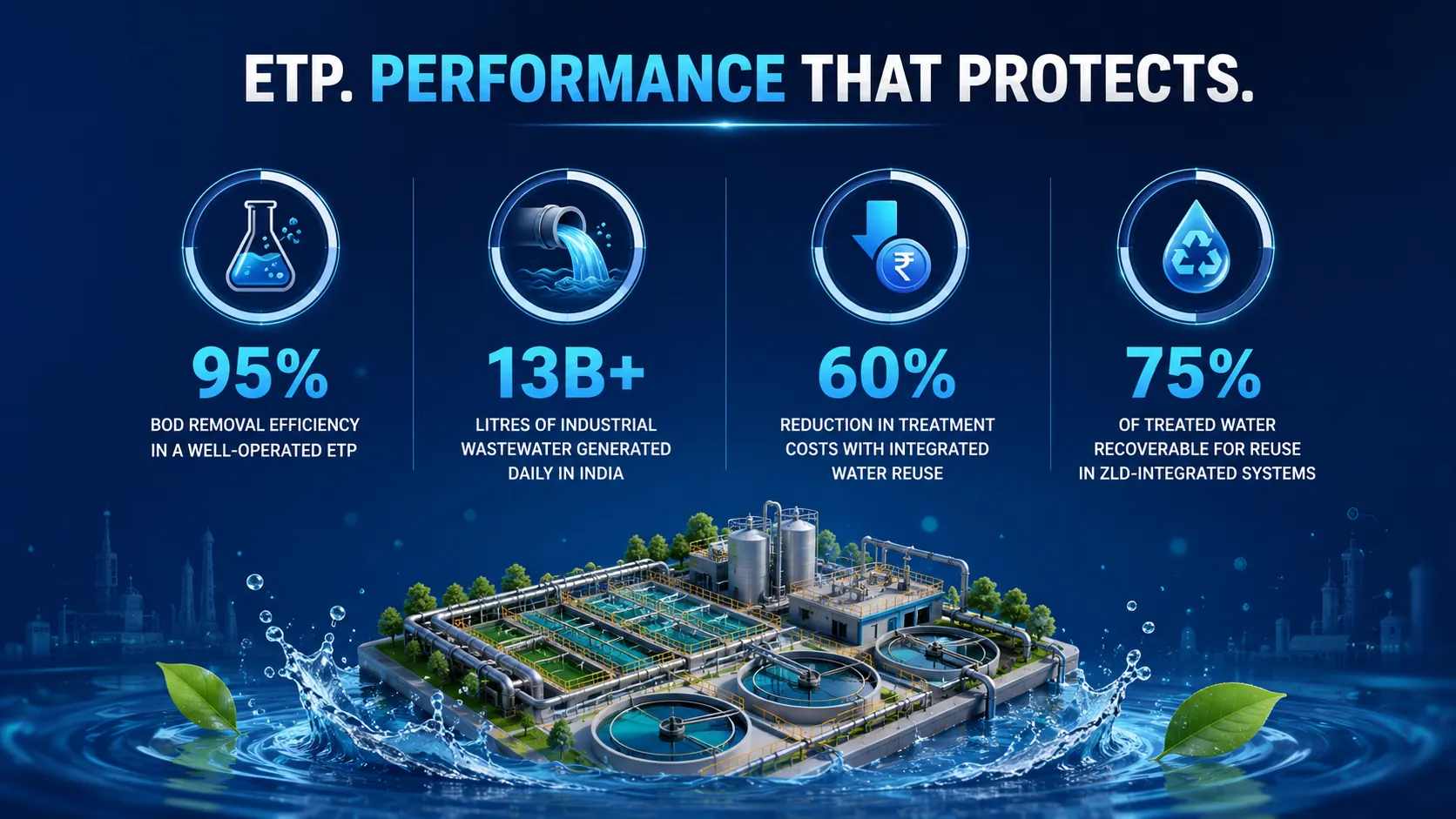
13.5B
litres of industrial wastewater generated daily across India — less than 60% is currently treated
₹10L+
penalty per violation under Environment Protection Act — plus potential criminal prosecution for owners
60%
reduction in treatment costs possible when ETP is combined with water reuse and ZLD recovery systems

According to the Central Pollution Control Board (CPCB), industries are among the largest contributors to river and groundwater pollution in India. The Ganga, Yamuna, and Cauvery river systems receive thousands of millions of litres of partially or untreated industrial discharge annually. Regulatory enforcement is intensifying — CPCB’s online monitoring mandate now requires industries above a certain scale to install continuous effluent monitoring sensors connected directly to pollution control boards.

For facility owners, the risk calculation is straightforward: the cost of a well-designed, properly maintained ETP is a fraction of one enforcement action, and the treated water it produces can offset freshwater procurement costs — turning a compliance cost into an operational saving.

Before vs After ETP: What Changes in Your Wastewater

A parameter-by-parameter comparison of raw industrial effluent vs ETP-treated output against CPCB discharge standards.

Parameter⚠ Raw Effluent (Typical)✓ After ETP Treatment
BOD (mg/L)High 300–2,000 mg/LCompliant <30 mg/L (CPCB limit)
COD (mg/L)High 500–5,000+ mg/LCompliant <250 mg/L
TSS (mg/L)High 200–1,000+ mg/LCompliant <100 mg/L
pHOften 2–4 (acidic) or 10–13 (alkaline)Neutralised 6.5–8.5 range
Heavy MetalsLead, chromium, arsenic often presentRemoved to below permissible limits
Colour / DyeHighly coloured — blocks sunlight in water bodiesDecolourised via coagulation or oxidation
Oil & GreasePresent in food, pharma, engineering unitsRemoved via DAF or oil skimming to <10 mg/L
PathogensPresent in food, pharma, and slaughterhouse unitsEliminated via chlorination or UV disinfection
TDSOften very high in chemical and dyeing industriesReduced further in ZLD-integrated ETP systems
Discharge StatusNon-compliant — illegal to dischargeCompliant — safe for discharge or reuse

6 Industries That Cannot Operate Without an ETP

Different industries generate different effluent — all regulated, all requiring systems designed for their specific contaminant profile.

How an ETP Works: The 6-Stage Treatment Process

A properly designed ETP treats industrial wastewater through a series of stages — each targeting specific contaminant types — before producing compliant discharge.

1
Preliminary Treatment
Screens and grit chambers remove large solids, rags, and debris from raw effluent
Primary
2
Physico-Chemical Treatment
Coagulation, flocculation, and pH neutralisation remove suspended solids, dyes, and heavy metals
Primary
3
Primary Clarification
Sedimentation tanks allow treated flocs and sludge to settle, clarifying the wastewater
Secondary
4
Biological Treatment
Aeration tanks with microorganisms (MBBR/ASP/SBR) digest dissolved organics and reduce BOD/COD
Secondary
5
Tertiary Treatment
Advanced filtration, activated carbon, or membrane systems remove residual contaminants and colour
Tertiary
6
Sludge Management & Discharge
Sludge dewatered and disposed per CPCB norms; treated water discharged or reused
Output

The ETP Journey: From Pollution Problem to Compliant Output

Follow the transformation of industrial wastewater through each phase of the ETP lifecycle — from problem to solution.

Phase 1 — Assessment
Water Quality Audit & ETP Sizing
Effluent samples are tested across 20+ parameters. Flow rates, peak loads, and contaminant profiles determine the ETP capacity, technology selection, and number of treatment stages required.
Phase 2 — Design
Engineering & Technology Selection
Civil layout, equipment selection, and process flow designed around your effluent characteristics. Different industries require different treatment trains — a textile ETP is fundamentally different from a pharmaceutical one.
Phase 3 — Commissioning
Installation, Testing & Biological Seeding
Equipment installed and civil works completed. Biological treatment stages are seeded with microbial cultures and run through a startup period to reach stable treatment efficiency before full operation begins.
Phase 4 — Operation
Daily Operation & Monitoring
Inlet and outlet quality monitored continuously. Chemical dosing calibrated, aeration adjusted, and sludge levels managed daily to maintain treatment performance within CPCB limits.
Phase 5 — Compliance
Regulatory Reporting & AMC
Periodic lab analysis submitted to SPCB. Annual maintenance contract ensures all mechanical, electrical, and biological components are serviced on schedule — maintaining compliance record and preventing shutdowns.

What Makes an ETP Effective — and What Makes It Fail

“The most common ETP failure we see is not a design flaw — it is operational neglect. A plant that was designed correctly but starved of maintenance, chemical dosing, or biological seeding will fail its compliance tests within months. An ETP is a living system, not a static installation.”

Key factors that determine ETP performance:

Accurate Effluent Characterisation: The ETP must be designed around actual, tested effluent parameters — not assumed values. Seasonal process changes also affect effluent quality and must be accounted for in design
Correct Technology Selection: A biological ETP designed for food processing effluent will not perform on tannery or electroplating wastewater. Technology selection must match the specific contaminant profile of your industry
Consistent Chemical Dosing: Coagulants, flocculants, pH adjusters, and nutrient supplements must be dosed at correct rates and frequencies. Under-dosing is the most common reason for compliance failures in operating ETPs
Regular Biological Health Checks: The microbial cultures in biological treatment stages need monitoring — MLSS levels, DO levels, and sludge age must stay within operational ranges or treatment efficiency collapses
Scheduled Maintenance & AMC: Pumps, blowers, diffusers, and dosing systems require routine servicing. An AMC with a qualified provider ensures nothing is missed and your compliance record stays clean
The Bottom Line: An ETP Is Not a Cost — It Is Protection

An Effluent Treatment Plant does far more than keep your facility compliant. It removes the contaminants that threaten communities, water bodies, and ecosystems. It recovers water that can offset freshwater procurement costs. And it protects your facility’s most valuable asset — its license to operate. The question for any industrial facility generating process wastewater is not whether to install an ETP. The question is whether your current ETP is the right one for your effluent profile — and whether it is being maintained to the standard required to stay compliant year after year.

If you are setting up a new facility, upgrading an underperforming system, or simply unsure whether your current ETP meets today’s CPCB standards, a qualified water treatment partner can give you the answers you need. Explore Nanneer’s range of certified Effluent Treatment Plants — designed and commissioned for industry-specific compliance across India.

⚠️

Need a Compliant Effluent Treatment Plant for Your Facility?

Our engineers will assess your effluent profile, recommend the right ETP technology, and design a system that meets CPCB norms from day one — no guesswork, no compliance risk.

Frequently Asked Questions

Simple answers to the most common questions about Effluent Treatment Plants.

What is the difference between an ETP and an STP?
An ETP (Effluent Treatment Plant) is designed specifically to treat industrial wastewater containing chemicals, heavy metals, dyes, and industrial-specific contaminants. An STP (Sewage Treatment Plant) treats domestic wastewater from toilets, kitchens, and bathrooms. ETPs are typically more complex because industrial effluent varies widely in composition and toxicity across industries.
Is an ETP mandatory for all industries?
Yes — under the Environment Protection Act 1986 and Water (Prevention and Control of Pollution) Act 1974, all industries generating process wastewater must treat it to CPCB/SPCB prescribed standards before discharge. Industries without functioning ETPs are liable to closure orders, financial penalties, and criminal prosecution of responsible persons.
How long does it take to commission an ETP?
A standard industrial ETP takes 3–6 months from design to commissioning, depending on capacity, civil construction requirements, and technology complexity. Biological stages require an additional 4–8 week startup period for microbial cultures to stabilise before the system reaches rated treatment efficiency.
Can ETP-treated water be reused?
Yes. Depending on the treatment level achieved, ETP output can be reused for cooling towers, floor washing, horticulture irrigation, and fire hydrant systems. When integrated with a tertiary treatment or ZLD system, up to 75% of treated water can be recovered and reused within the facility, significantly reducing freshwater procurement costs.
How often does an ETP need to be serviced?
An ETP requires daily operational monitoring (chemical dosing, DO levels, sludge management), monthly mechanical and electrical checks, quarterly deep servicing of blowers, pumps, and diffusers, and a full annual audit with regulatory compliance reporting. An Annual Maintenance Contract (AMC) with a qualified provider is the most reliable way to ensure this schedule is maintained.
Share it on
Facebook
Twitter
LinkedIn
Reddit
WhatsApp

Looking for Water Treatment Expert?

Nanner is team of water treatment experts for affordable solution.
WhatsApp